The 10 iconic butterflies of Madagascar
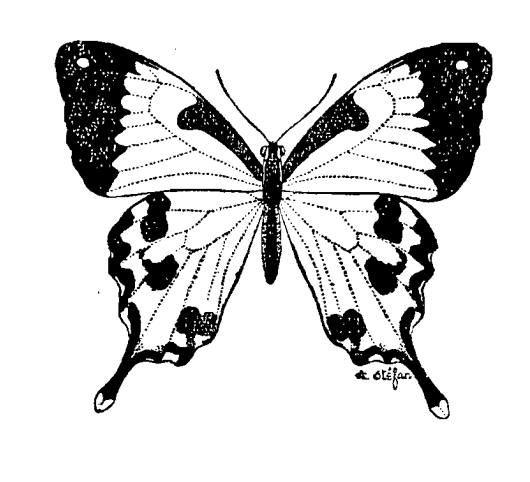
Madagascar is an island known for the lemurs that live there and for its unique wildlife. The red island, celebrated for the warmth of its inhabitants and the originality of its lands, has unusual resources spread throughout the island. They are predators, brightly colored, heralding change, happiness, and luck for some, and death for others. They live in groups and can be found both day and night, crawling and flying: butterflies are a species with many varieties on the big island.
Associated with mysticism and souls, the animal is fertile, lives, and spreads to the rhythms of the island’s circumstances.
An animal symbolizing lightness and freedom, it has a favorable environment for procreation. Its population varies according to changes in its natural habitat. In this article, we take a look at 10 iconic butterflies of the island of Madagascar. From the largest to the smallest, including the most mythical, we tell you everything.
1-The largest day butterfly in Madagascar: Papilio Antenor.
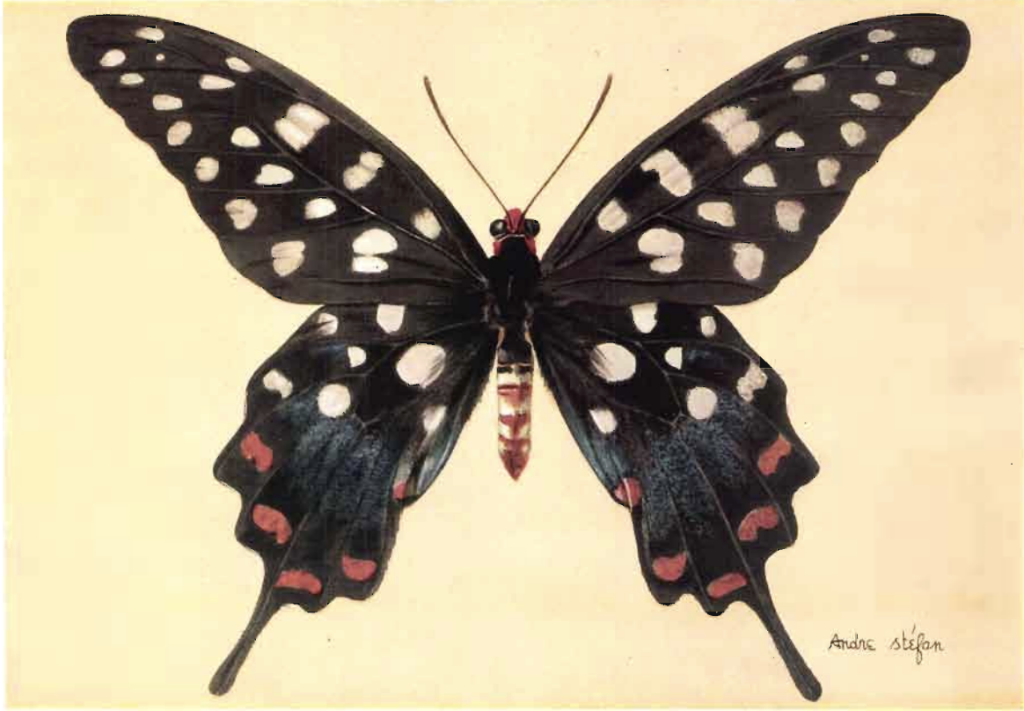 With a wingspan of over 13 cm, Papilio Antenor is the largest butterfly on the island of Madagascar. It is characterized by flights of 4 to 3 m in height with slow wing beats, and it can fly long distances of up to 30 km. Its wings are black with white spots on the upper parts. Orange spots are found on the underside of the butterfly. In its caterpillar form, it is green and plump. Its skeleton and chrysalis are also fleshy. In Africa, the butterfly is only found in Madagascar, but it is also found in Asia and America.
2-The largest moth in Madagascar: The Madagascar comet moth, also the largest insect in the world.
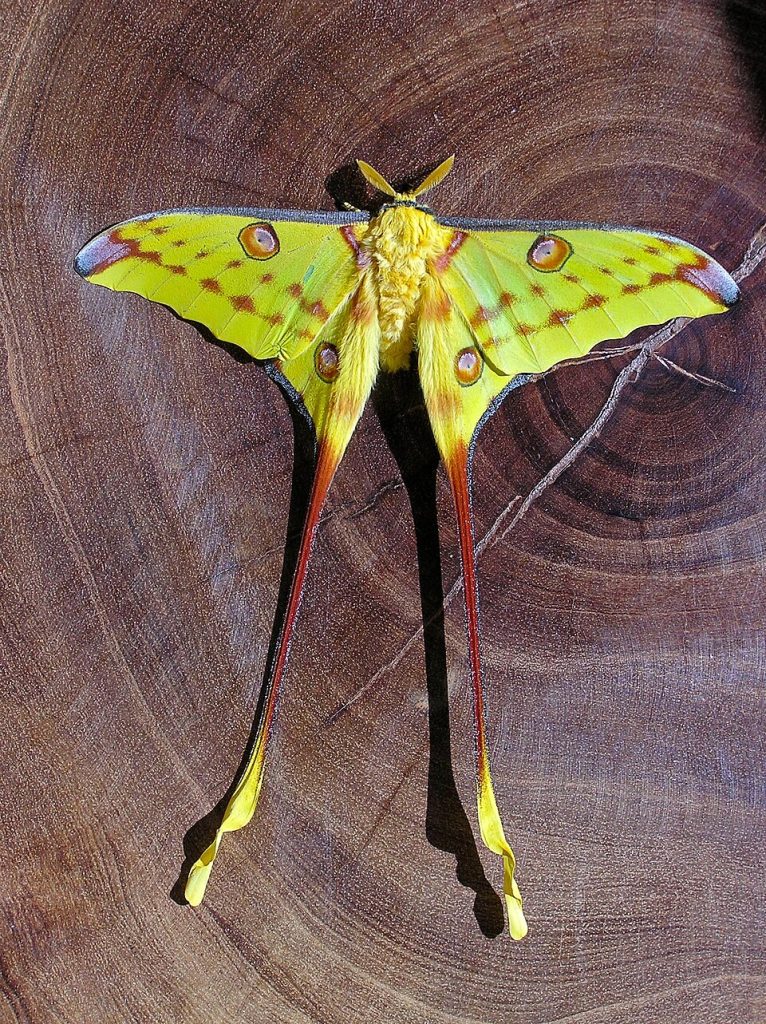 Named for its star-like shape, the comet moth can reach up to 20 cm in length thanks to its rear tail, and with a wingspan of around 30 cm, it is the largest moth in Madagascar and one of the largest insects in the world. It is found in the rainforests of Madagascar, particularly in the southern forests. It should be noted that after transformation, the new moth only lives for 6 to 7 days. They have atrophied proboscis, which limits their survival, forcing them to live on their reserves. The female Argema mittrei lays up to 120 to 170 eggs.
An interesting fact about this iconic butterfly is that it was printed on the old 1000 ar banknotes by the Central Bank of Madagascar.
3-The nyctipao walkeri or ‘lolo’ of Madagascar:
 Rest assured, its name has nothing to do with breasts, nor with the first names Laurent, Laurence, Laura, Loïc…
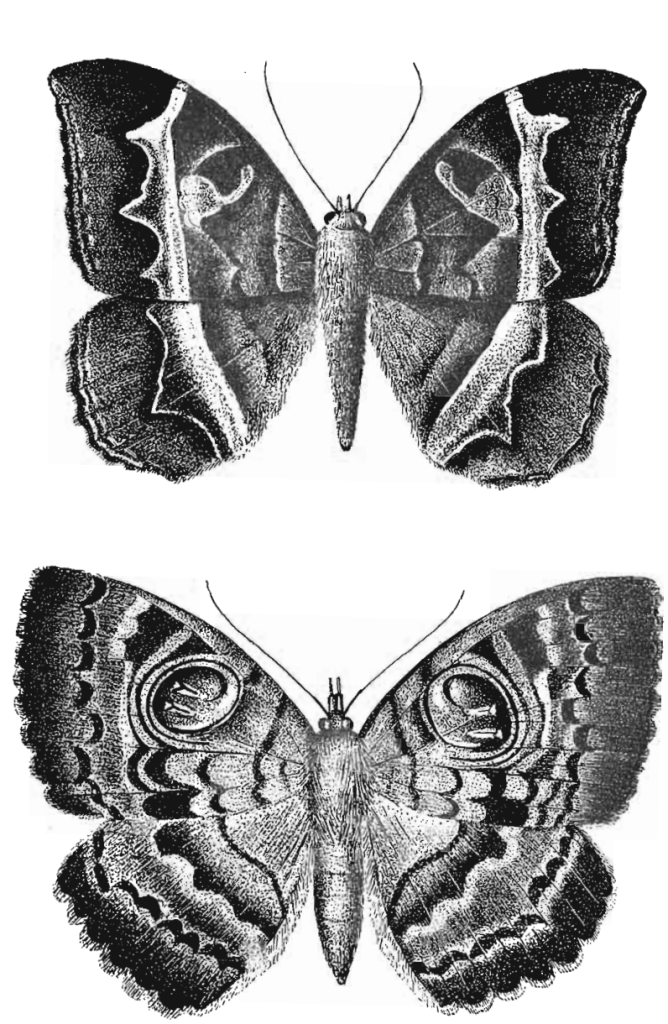
Lolo is the Malagasy name given to Nyctipao walkeri. It is so named because it is associated with ghosts and evil spirits, which it is said to represent in popular culture. According to local beliefs, it is a harbinger of bad luck and is both avoided and feared by the Malagasy people.
This belief is rooted in the behaviour of the nyctipao walkeri: the moth hides in dark corners of houses and flies sluggishly. The moth has an eye on the front of its wings and a line separating the basal part of the wing from the terminal part.
This appearance reinforces the beliefs surrounding this species of moth.
4-The ‘lolondrafy’ or Antherina suraka, a silk supplier.
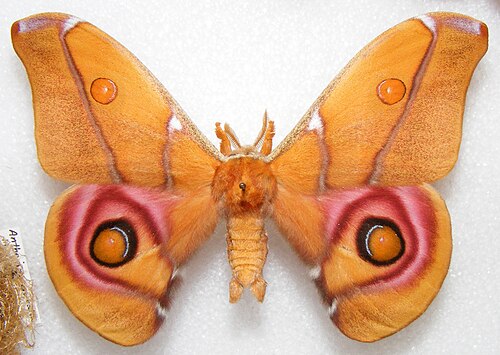 A butterfly of the Saturnidae family, Antherina suraka is a common butterfly in Madagascar that appears mainly in the Madagascan autumn in March, April and May. It exhibits sexual dimorphism: the male has brighter yellow wings and pectinate antennae. The species is known to be exploitable for use as a silk supplier. The chrysalis shelters in a double-layered cocoon made of strong yellowish silk. The male cocoon is larger than the female cocoon.
The caterpillar of the antherina suraka is particularly voracious and fond of the leaves and produce of Madagascan gardens.
5-Pyralis pictalis: the moth attracted to light.
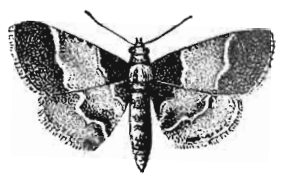 This is Madagascar’s house moth. Pyralis pictalis is yellow with brown and white stripes. It lives in piles of clothing and food supplies and preys on bedbugs, cockroaches, beetles and other household insects. The moth is 15 to 20 mm long. It has two antennae at the end of its head. When touched, it releases a fine layer of dust characteristic of the species. Its wings are water-repellent, and it moves more at night than during the day. It is very attracted to light sources. This is the species you will see accompanying you at night, heading towards your light source.
Its larvae are very fond of flour (all types of biscuits), cereals, dried fruit, rice, corn, etc.
6-Acherontia atropos or ‘death’s-head hawk moth’: the European moth
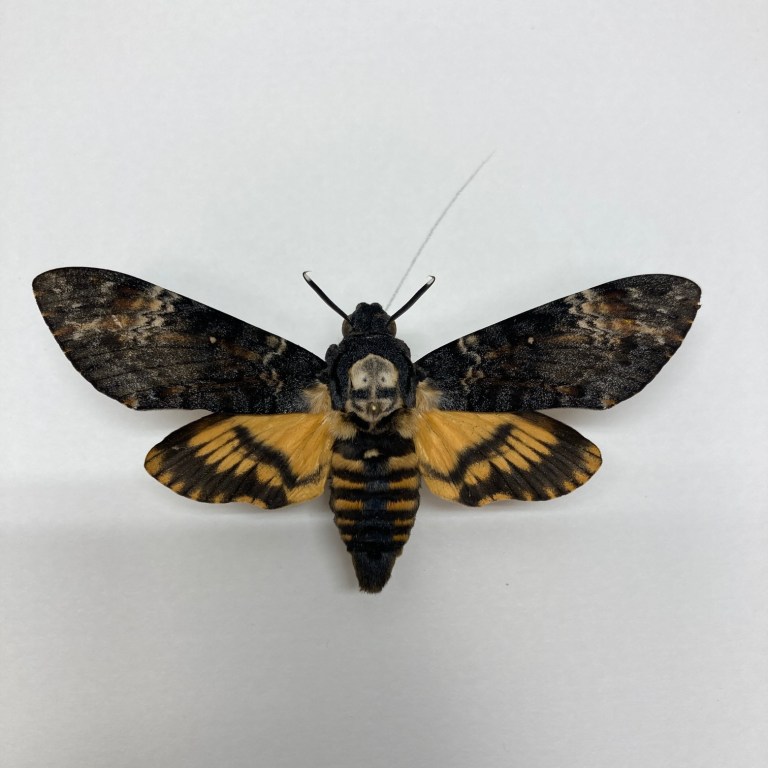 One of the largest moths in Europe, the death’s-head hawk moth owes its name to the pattern on its thorax. It is a European moth that has colonised Africa and Madagascar. It measures approximately 6 cm and has a wingspan of around 13 cm. Its back is covered with hairs. The moth has a powerful flight. It is a moth with a powerful cry, like that of a mouse. It cries out when caught, frightened or attacked.
It lives in a hive and feeds on insects and honey. The female weighs around 15 g. It does not damage plants. It is omnipresent in popular culture: on the poster for the American film The Silence of the Lambs, in the film Un chien andalou, and very present in the book The Butterfly Effect by Jussi Adler Olsen, as well as appearing in other novels.
7-Lycaenidae: the butterfly net butterfly.
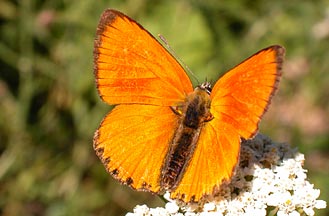 A small blue butterfly found on all the hills of Madagascar. The Lycaenidae family is the standard species of butterfly found in flowers and meadows. They come in many colours and have a filamentous tail extending from their hind wings. The species exhibits sexual dimorphism, with females being more colourful than males. This is the butterfly found attached to the pistils of flowers, hunted with a net in cinematic representations of butterflies.
In their caterpillar form, Lycaenidae are highly dependent on their living environment.
8-Melanitis leda fulvescens: the crop destroyer.
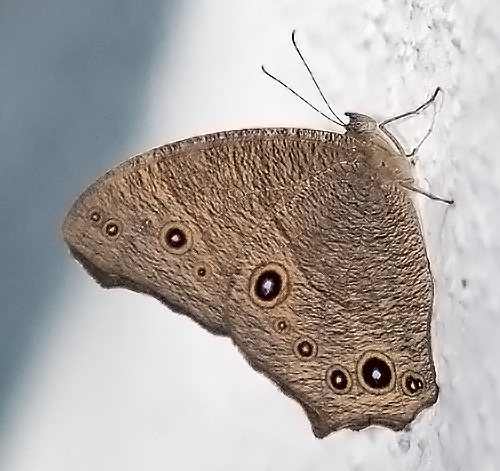 Found in Mauritius, Réunion and Madagascar, Melanitis leda fulvescens is a herbivorous moth measuring 6 to 8 cm. It is known to attack sugar cane, rice and cassava crops, sometimes causing serious damage.
The species has seasonal dimorphism, which is rare: it is grey during the dry seasons and brown during the wet seasons. In addition to cultivated areas, it is found in the plains.
Another peculiarity of the moth is that it tilts to one side when resting, which reduces its shadow and helps it regulate its temperature. However, the moth continues this behaviour even after sunset, when it no longer serves any purpose.
The moth is most prevalent from January to May and September to December, and rare from June to August.
9-Amauris nossima: a rare butterfly.
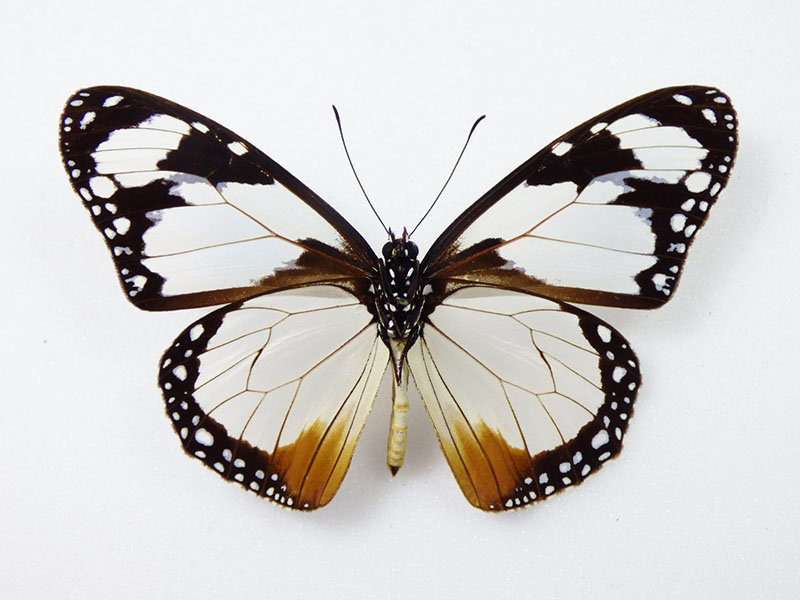 A rare butterfly found in Mauritius, Mayotte and Madagascar, the amauris nossima measures 6 to 7 cm. It flies during the day, flying fast and high. It lives in tropical forests and particularly likes forests near the coast. It feeds on nectar, leaves and rotting fruit. It lives in groups and flies in flocks of 3 to 4 individuals.
Its colours are silvery white, orange and black at the tips of its wings.
Its rarity could be explained by the gradual disappearance of its habitat.
10-Papilio menestheus Lormieri: a butterfly distinguished by its colours.
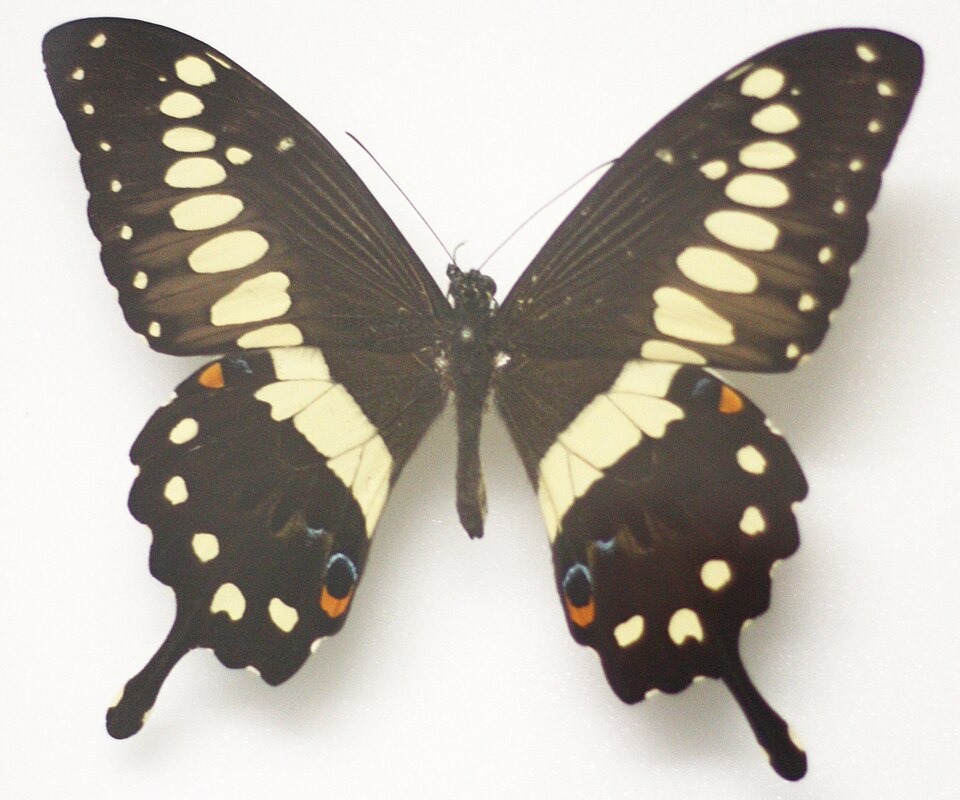 A large Papilio with a wingspan of about 7 cm, this butterfly is a species generally found in West and Central Africa. It is a species that stands out for its aesthetics: it has a white band with rounded submarginal spots on its back. A blue lunule is visible at the edge of the wing. The front of the wing has the same spots with additional blue lunules.
The butterfly lives in rainforests. It is a rare species in Madagascar but quite common on the African continent. This butterfly is distinguished by the colours displayed on its wings.